Environmental News
Upcoming and Recent Events:
Weekly Guided Nature Tours, Weekend Mornings Throughout the Month – Each month, the Mashpee Conservation Department sponsors guided walking tours, which are free of charge and weather dependent. For directions and information about these walks, click on the “Guided Nature Tours” link along the left-hand margin at the department’s main website, www.mashpeema.gov/conservation. Walks have included Childs River, Lowell Holly Reservation, Mashpee River Woodlands, Pickerel Cove, Santuit Pond Preserve and many more. This is a great way to explore Mashpee’s wonderful array of conservation lands.
Save the Dates (additional details will follow):
Saturday, April 18, 2026, Honor the Earth Fair, Mashpee Wampanoag Tribal Center
Saturday, April 25, 2026, Earth Day Textile Recycling, Composting, and Secure Shredding Event – co-sponsored by Mashpee DPW and MEC, location to be arranged
Check back soon for details!
Information Items:
Proposed New Sewer Phase Map – Mashpee Wastewater Management Project: A map of proposed Sewer Phases was presented to the Mashpee Sewer Commission on December 18, 2025. Sometime within the next few months, a joint meeting with the Mashpee Select Board may be scheduled for discussion and approval of this proposal. A copy of the map is available here. To watch the discussion, click here and start at hour 1, minute 45.
APCC Releases its State of the Waters: Cape Cod 2025 Report: In early December 2025, the Association to Preserve Cape Cod (APCC) released its latest data regarding Cape Cod’s State of the Waters in our estuaries, ponds, and municipal water supplies. Details may be found at: https://capecodwaters.org/.
Cape Cod Freshwater Strategy Report – Ponds and Lakes: The Cape Cod Commission released its final Cape Cod Freshwater Strategy Report this past summer. This guide outlines a data-driven approach to evaluating, protecting, and restoring Cape Cod’s ponds and lakes, and a framework for improving their overall health. Additional information and the report itself may be found here.
Reminders:
MEC’s Chemical-Free Cape Cod Yard Sign Campaign: In April 2025, MEC launched its new “Chemical-Free Cape Cod Yard” sign campaign – aimed at promoting Chemical-Free Yards that are safe for our Children, Pets, Waters – and Nature as a whole. Already, our signs are proudly being displayed in yards across Cape Cod, including Dennis, Falmouth, Mashpee, Pocasset, and Sandwich. For a donation of just $10, Cape Cod residents who care about the environment can show their support by displaying one of our signs in their yard, setting an example for family, friends, and neighbors. Additional information is available here. Thanks to all who are helping to save our environment – one yard at a time!
Cape-Wide “Perpetual” Conservation Calendar: The Compact of Cape Cod Conservation Trusts and its nonprofit members currently maintain a Regional Calendar of Events, that is updated on a continual basis. This Conservation Calendar includes programs from villages and towns across Cape Cod, encouraging both visitors and residents to take part in nature and environmental events. The wide list of current programs may be accessed at: www.blt.org/capeconservationcalendar.
Textile Recycling is Now the Law! As of November 2022, in Massachusetts it is now illegal to discard any clothing or other textile items in the trash, even if stained, ripped, threadbare, or filled with holes. The full list of items that must now be recycled may be accessed at the link provided, courtesy of Bay State Textiles. MEC is currently holding textile drives twice each year — in April as an Earth Day event, and in August alongside the Hazardous Waste Dropoff. Exact dates and times each year will be posted above under “Upcoming Events”. More information may be found at: List of Clothing and Textiles that must now be Recycled.
Like Ospreys? Thanks to the Friends of the Mashpee National Wildlife Refuge and Comcast, you can now watch – and listen to – the osprey nest of Rachel and Carson and their two new babies located at the Waquoit Bay National Estuarine Research Reserve. To access this live feed, click on the link below, then “Osprey Cam” at: https://www.friendsofmashpeenationalwildliferefuge.org/
Important Fertilizer Reminder: Mashpee regulates the application of fertilizer as follows:
1. No application of nitrogen is permitted between October 30 and April 14 — or at any time within 100′ of specified waterways
2. No application of phosphorus is permitted between December 1 and March 1 — or at any time within 20′ of specified waterways
Even during acceptable dates, no application is permitted before or during a heavy rainfall or when the ground is saturated. These regulations are detailed in the Nitrogen Control Bylaw, amended 2017, available at www.mashpeema.gov, under Town Clerk. However, please note that Mashpee Town Manager, Rodney C. Collins, issued a Special Water Quality Alert to all property owners asking them to discontinue the use of fertilizers on lawns and landscaped areas. This alert is available at https://www.mashpeema.gov/home/news/special-water-quality-alert-july-2021. Thank you for helping to keep Mashpee’s waterways clean!
In Case You Missed It:
Source to Sea Restoration Projects – The Town of Mashpee is currently working with the Association to Preserve Cape Cod (APCC), Waquoit Bay National Estuarine Research Reserve (WBNERR), and the Mashpee Wampanoag Tribe on the restoration of the Mashpee River, Quashnet River, and Red Brook. This project is funded in part by a grant from NOAA. Community Partners for all three projects are still being sought. For additional information about these projects and/or to become a community partner, go to: https://waquoitbayreserve.org/coastal-training-programs/source-to-sea.
Session Videos and Resources from the 2024 Cape Cod Coastal Conference – The June 18, 2024, full-day WBNERR conference entitled “Collaborating for Solutions: Practical Sessions to Achieve Watershed Plans” focused on ways that our Cape Cod communities can take action to restore water quality, reduce nutrients in our watersheds, and apply for funds to assist in implementing Watershed Plans. The full Conference Agenda, Session Videos, and a link to Grant Opportunities and Deadlines are available at: https://waquoitbayreserve.org/2024-cape-coastal-conference/.
Pond Oxygenation Workshop – A Special “Shout Out” to the Waquoit Bay Reserve for their informative, full-day workshop in November 2023 on how to manage healthy ponds by using oxygenation – and no chemicals. This technique has proven successful in lakes and ponds across the US, as well as right here on Cape Cod with Sarah’s Pond in Orleans – thanks to an initiative undertaken by the Orleans Pond Coalition. The full-day program, including agenda, presenter information, and PowerPoints may be found at the link below. For anyone interested in learning more about a fully natural way to help manage our freshwater ponds, this approach is well worth exploring: https://waquoitbayreserve.org/pond-oxygenation-workshop-learning-through-case-studies/
Monthly Board of Directors Meeting Schedule
Board meetings of the Mashpee Environmental Coalition (MEC) are held via Zoom the second Thursday of each month (January to November) starting at 4:00pm unless otherwise noted. There is no meeting in December. Please note that our Annual Meeting takes place the second Thursday in September at 4:00pm followed by the September board meeting.
All are welcome to attend. If you wish to attend one of our meetings, please contact [email protected] by 12:00 noon the day before the meeting so the Zoom link can be emailed to you.
Waste Water
The nutrient over-enrichment of our ponds and estuaries and the resultant noxious/harmful algae blooms that occur are fed, in a great degree, by the minimal treatment activity available from the many septic systems standard in our area. As the population grows the resultant sewage volume also grows increasing the intensity of the problem.
Over 30 years ago residents noted the declining water quality in our estuaries and engaged in a questioning and activism activity to understand and combat this obviously growing problem. Following a series of ″jawboning″ efforts and a series of town committees addressing the declining conditions a 1997 study was funded. That study confirmed the problem and established the need for a more in-depth review of the causal factors in order to develop a mitigation plan.
The Town of Mashpee Sewer Commission has undertaken the development of a a “Comprehensive Watershed Nitrogen and Wastewater Management Plan”. Baseline data for calendar year 2001 and data developed by Mashpee Volunteers beginning in 1997 with lab analyses by the School for Marine Science and Technology, UMASS, Dartmouth resulted in a 2004 technical report for Popponesset Bay followed a few years later for the Mashpee portion of Waquoit Bay. These reports were the basis for Massachusetts prepared documents outlining the current conditions and maximum levels allowable to restore our troubled waters. These reports known as ″Total Maximum Daily Loads″ are required by the Clean Water Act and must receive approval from the regional EPA to become an official regulatory requirement. This approval has been forthcoming.
Mashpee funded the remedial planning effort by over $500,000 ($405,140 authorized May and $40,000 authorized October of 1999), plus past and additional studies with continued volunteer water sampling mandating lab analyses. The planning is intended to provide a road-map to the eventual resolution to the serious and growing decay of our estuarine waters due to nutrient pollution.
An Environmental Notification Form (ENF) was submitted to the Executive Office of Environmental Affairs. The Secretary’s Certificate (November 9, 2001) requires a Draft and Final Environmental Impact Reports. The Certificate also notes the Project is subject to joint review with the Cape Cod Commission as a Development of Regional Impact. Engineering / Scientific Support Contracts have been negotiated and a “Community Advisory Committee” established.
The planning activity is ongoing at this time and has experienced significant difficulties along the way. One major glitch has been the reorganization of the Sewer Commission from a three member to a seven member Commission with only one of the original Commissioners retained. As infrastructure plans are developed they need to be tested by the scientific community for compliance to the computer models developed for our watersheds. At this time we have a mix of compliant and non-compliant potential approaches with costs that vary from approximately $250 million to $500 million.
In addition to the minor road blocks that should be anticipated for a project of this size and complexity, there are two major hurdles that should have been addressed long ago to establish a solid planning basis.
The first hurdle is the lack of any discussions towards an agreement from the watershed participants (Mashpee, Barnstable and Sandwich for Popponesset and Mashpee, Sandwich and Falmouth for Waquoit) relating to what share of each watershed´s allowable limit should be allotted to each watershed sharing town.
The second major hurdle is planning for acquiring the funding needed to design and construct the needed piping and treatment facilities. It appears the largest source of funding will be local and may be taxes, betterments, fees or other sources. As is likely, not all properties will require connection to a sewage treatment plant, yet theoretically all properties will benefit from restored and protected waters. This raises the question of who should pay and how.
Mashpee residents should learn all they can about this major endeavor that will have a major impact on their wallets and environmental ″Quality of Life″. MEC will continue to follow the progress of the wastewater remediation activity in Mashpee as a standard item in our quarterly newsletter.
Renewable Energy
Mashpee, as a Green Community, has committed to reduce energy consumption 20% or more over the 5 year period ending 2014. As most of Mashpee’s Town buildings are already energy efficient, generation of renewable energy (solar, wind) will be used to assist in reaching the 20% goal.
A British Thermal Unit is the amount of energy needed to raise the temperature of one pound (16 Ozs.) of water One degree Farenheit. It is a convenient unit of measure to sum energy use from varying sources into an overall baseline to view total consumption. Some BTU equivalents utilized for total power computations are
| Item | Unit | BTU |
| Gasoline | 1 Gallon | 125,000 |
| Natural Gas | 1 Cubic Foot | 1.000 |
| Electricity | 1 kwH | 3,412 |
Computing BTU consumption for larger facilities usually entails large numbers so the prefixes “M†or “MM†are frequently used to indicate millions of BTUs.
Mashpee has categorized town energy consumption into Building (Gas and electricity), Fleet (Automotive fuel) and Lights (Street & Traffic).
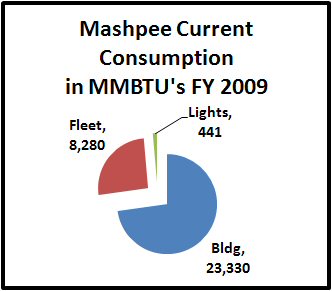
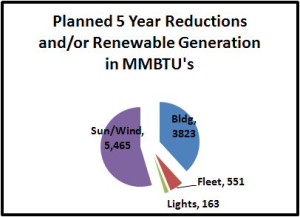
Progress to date includes the signing of a Power Purchase Agreement for an approximately 350 kilowatt system for the High School, Senior Center and Town Hall that is rated to produce over 381 kilowatt hours of electricity in its first year of operation. (1,300 MMBTU.